
FF-ICE: Changes Coming to Flight Plan Filing in Europe from 2026
FF-ICE (Flight and Flow Information for a Collaborative Environment) will bring the most significant change to flight plan filing in Europe since the introduction of the FPL2012 format, starting January 1, 2026. Led by EuroControl and the SESAR Deployment Manager, this global ICAO initiative, enforced through Commission Implementing Regulation (EU) 2021/116, requires Airspace Users’ and ANSPs’ systems to support the exchange of FF-ICE/R1 filing services.
READ ALSO: Attend our FF-ICE Follow-Up Webinar on November 11, 2025
What is FF-ICE?
The project is split into two releases, where Release 1 (FF-ICE/R1) focuses on pre-departure information, and Release 2 (FF-ICE/R2) involves post-departure information sharing. In its final form, FF-ICE will allow for:
- Flights to be filed up to one year in advance using a GUFI
- Flight plans to be dynamically updated throughout all phases of the flight (pre and post-departure)
- Share information on the flight to all Stakeholders
- Exchange trajectory and performance data
- Post-flight data analysis
How FF-ICE Differs from FPL2012
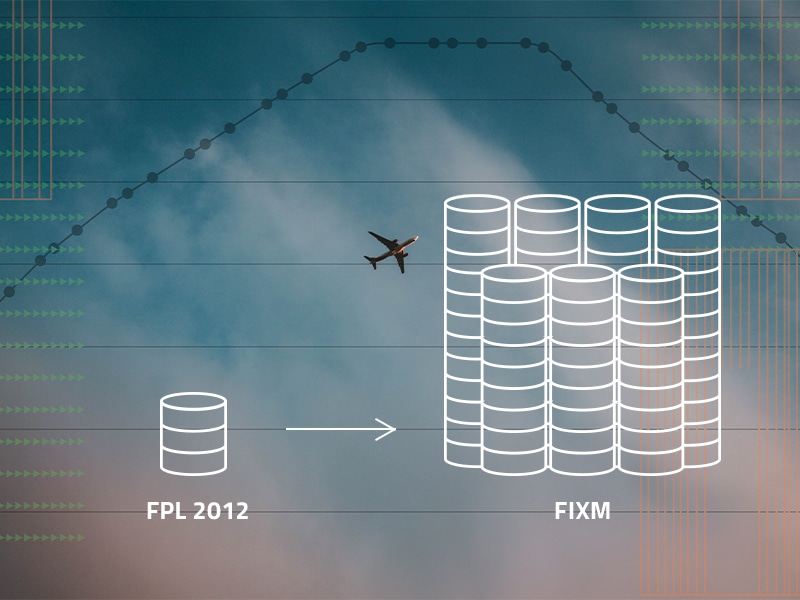
The current use of FPL2012 is based on the architecture from where flight planning is a paper-based, human-interpreted system with limitations necessitating the need for interpolation and free text. FF-ICE will transform the present-day flight plan and flight planning process as it allows for more information to be exchanged, including specific Climb/Descent profiles, speeds, weather used for optimization, aircraft mass, estimated times over (ETOs), etc. This data will be transmitted as an extended flight plan (eFPL) using the Flight Information Exchange Model (FIXM) format.
With all Stakeholders using the same flight data, access to real-time updates on route restrictions from ATC and regulatory constraints will result in more effective and strategic flight planning. The increasing capabilities to ingest and utilize different data sources are expected to provide dispatchers and flight crew with accurate advance and real-time changes in airspace capacity, congestion, airspace unavailability, and other factors that may impact the flight operation. This will enable airlines to optimize routes and minimize delays.
Compliance and Testing Phases for Airspace Users
Whilst EU 2021/116 mandates Airspace Users (AU) to file an eFPL, the computer flight planning system provider (CFSP) must provide the filing tool; without the tool, the AU is non-compliant. CFSPs are in various states of readiness with most having migrated from the development phase to the testing phase. The testing phase is multi-faceted as it requires NM to approve the CFSP and the individual Airspace User. NM has structured the testing requirements as follows:
- Individual CFSP testing for formal compliance
- A single Airspace User nominated by individual CFSPs to conduct parallel testing (FPL and eFPL)
- Each Airspace User thereafter must conduct their own testing based on NM’s Use Cases.
Once NM is satisfied that each Airspace User complies with the Use Cases, the Airspace User will be granted approval to file eFPLs.
Given the testing phases required, it is imperative that ERA members remain apprised of their CFSP’s testing and implementation plans. It is anticipated that there will be a backlog for pre-operational testing slots with NM for each Airspace User to gain approval to file live/operational eFPLs.
Operational Changes for Airlines
Operationally, there are a number of items that will change and require the airline to prepare for:
- Loss of familiarity involving the FPL2012 format
- The eFPL in FIXM format – unreadable to humans and consisting of hundreds of lines.
- Workflow methodology of filing an eFPL may differ.
- Mixed-mode filing for flights operating in and out of the EATMN.
- Additional Dispatcher training and updating of manuals.
Future Implementation and Long-Term Outlook
Looking at future evolutions of FF-ICE, ICAO has set a global objective for all ANSPs to transition to eFPLs by 2034. Given the challenges facing European ANSPs, ICAO’s objective is bold. Within the EATMN, ANSPs are indicating that the 2028-2029 timeframe appears to be the peak period of implementation; however, some ANSPs do not foresee being FF-ICE compliant until 2032.
The impact to ERA Members is that each Airspace Operator must file an eFPL in accordance with EU 2021/116; however, the non-capable ANSPs will not benefit from the additional data as they will receive a generic FPL. Thus, the anticipated benefits for the Network will not be realized for many years.
Within various forums, work continues on the requirements of FF-ICE/R2, especially regarding the implementation of services. As FF-ICE/R2 is dependent on the adoption of FF-ICE/R1 beforehand, there remains time to apply lessons learned and refine the requirements. Within this context, ICAO has not provided guidance on FF-ICE/R2 implementation dates.
Throughout 2025, the implementation of FF-ICE will require a collective effort between the Airspace User, the CFSP, and NM to ensure that all parties are capable to file eFPLs to meet the mandate depicted in EU 2021/116. ERA members are encouraged to remain aware of the requirements and prepare accordingly to ensure a smooth transition starting January 01, 2026.
Frequently Asked Questions
Can a User still send a CHG/DLA message over AFTN?
Yes, the AFTN network and the legacy functionality can still be used. The User must be aware that sending a CHG/DLA message via AFTN will have the following impacts: 1) Non-compliance with CP1 as information is not being transmitted via the B2B FF-ICE Filing Service; and 2) the FF-ICE version identifier on record at EuroControl will not be updated.
What is the impact on AU and ANSP?
In the Common Project/1 (CP1) cited in European Commission Regulation 2021/116, Airspace Users (AUs) are mandated to file a FF-ICE flight plan and ANSPs are required to ingest and use that data.
When will global FF-ICE implementation occur?
ICAO endeavours to have the global implementation of FF-ICE by 2034.
Author
More News On FF-ICE

Aircraft Commerce FLOPS 2025
AIR SUPPORT will exhibit at the 18th Annual Flight Operations Conference, taking place December 3–4, 2025, at London Heathrow. Visit booth 10 to see...
ICAO FF-ICE Follow-Up Webinar
Join Our Upcoming Webinar:FF-ICE – updates based on EuroControl conferences held in the last 4 months AIR SUPPORT will host a follow-up webinar on...

Aircraft Commerce AMER 2025
Meet AIR SUPPORT at Aircraft Commerce 2025 in Miami AIR SUPPORT is heading to Miami this September for Aircraft Commerce’s Airline & Aerospace...