

Benefits of Continuous Climb/Descent Operations
When most consider how to reduce fuel burn, the cruise phase of flight is often given the most attention. While this makes sense given that the aircraft is cruising for most of the flight’s duration, the climb and descent portion is often overlooked.
During the climb, thrust levels are generally higher, the aircraft is at its heaviest, and the airspace is constrained. With this month’s Monthly Flight Operations Focus, we will delve into how operational efficiencies can be gained in the climb / descent portion of flight and factors impeding such efficiencies.
Video Tutorial: How to include SID and STAR in PPS X
What is Continuous Climb/Descent Operations (CCO/CDO)?
Continuous Climb Operations (CCO) and Continuous Descent Operations (CDO) are flight techniques enabled through appropriate airspace and procedure design and supported by air traffic control clearances which allow aircraft to fly profiles optimized to their performance capabilities.
CCO allows departing aircraft to climb continuously to their initial cruise altitude at optimal airspeeds and thrust settings, thereby reducing fuel consumption, emissions, and noise. Similarly, CDO enables arriving aircraft to follow an optimized, continuous descent using low thrust and low-drag configurations, minimizing fuel burn, emissions, and noise.
The optimal vertical profile is a continuously climbing trajectory, and any non-optimal climb segments introduced to meet aircraft separation requirements should be avoided. However, achieving this while also supporting CDO and maximizing overall airport capacity depends heavily on airspace design and the level restrictions applied through flight procedures or air traffic control clearances.
Effective design requires a thorough understanding of the optimal aircraft performance profiles at the airport to ensure procedures strike a balance between minimizing level-offs and speed constraints that degrade climb efficiency and accommodating other airspace users. Well-designed airspace should reduce the need to manage conflicts between arriving and departing traffic through ATC-imposed level or speed restrictions.
SID and STAR Design Considerations
The structure of SIDs and STARs often depends on airspace design and ATC procedures, but there’s still room for optimization. SID/STAR procedures need to be developed in a manner whereby they allow for the most optimal routings while avoiding conflicting traffic.
Thus, SID/STARs must be designed with consideration to the flight characteristics, limitations, and the aircraft performance capabilities encompassing a swath of aircraft type.
The climb phase-of-flight entails the highest thrust settings and highest rate of fuel consumption. Starting with the departing or arriving runway, the CCO/CDO SID/STAR should be created to allow inhibited flows between the runway and the procedure transition waypoint.
This applies to the intended aerodrome but must also consider other aerodromes in the areas. Ideally, a procedure would be created to allow unrestricted routing to/from the aerodrome, including crossing altitudes and speed restrictions. To accomplish this, traffic flows, terrain, restricted airspace, generic aircraft performance, and noise must be considered to accomplish a balanced SID/STAR design.
See how easy it is to change SIDs and STARs in PPS Flight Planning
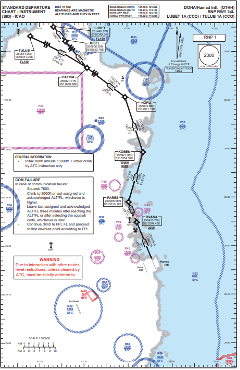
Source: Qatar Supp 01/2025-03
Applying CCO/CDO in Operational Use
Operational use of the CCO/CDO involves optimal performance profile selection, aircraft configuration, and limited flight level requirements. As the aircraft is within the vicinity of the aerodrome, consideration should be given to flaps, slats, spoilers, and gear – all of which will impact the noise and fuel consumption.
To accomplish this, greater speed management will be required by flight crew as a clean configured aircraft will have higher Ref speeds – especially on approach. Ideally, the FMS would provide the optimum speeds based on the selected CCO/CDO procedure.
Despite a CCO/CDO being a SID or STAR, there are additional requirements on flight crew to consider. Unrestricted climbs to cruise are the most efficient operations; however, risk is injected if amendments to the climb are given once airborne as such injection may not be expected and require a reconfiguration of the FMS. Therefore, minimizing flight deck workload shall be accounted for when designing a CCO/CDO.
Additionally, the term continuous climb or continuous descent implies unimpeded restrictions to top-of-climb or bottom-of-descent. To ensure optimal use of the CCO/CDO, additional briefings may be required when flying a CCO/CDO procedure: speed or FL restrictions, noise abatement, optimal speed selection, unanticipated ATC interventions.
 Source: https://upload.wikimedia.org/wikipedia/commons/1/16/Qantas_Boeing_737-800_spoiler_deployed_for_descent.jpg
The Role of Air Traffic Control in CCO/CDO Operations
The procedure design and flight plan are based on optimal environmental conditions. Once the flight is operational, tactical adjustments must be made by the ATCO who has the real-time perspective of the sector they are working. Thus, a Controller must be aware of providing proper separation while removing impediments to a flight on a CCO/CDO SID or STAR.
The prevailing notion of reaching top-of-climb as quickly as possible may not be the most efficient trajectory as flight crew may have selected a lower thrust climb profile. Conversely, tactical re-routing on the procedure can bring benefit as reduced track mileage is flown, although the ATCO must be aware of the noise regulations in the re-routed airspace. Ultimately, the flight crew must determine if a shorter route can be accepted due to aircraft performance.
In order to apply CCO/CDO, Controllers should be given adequate training on the benefits – and consequences – of CCO/CDO. The training should include the airspace design, pre-determined factors to avoid conflicting traffic, an understanding of aircraft performance, and the necessity to use standard ATC phraseology.
Because CCO/CDO procedures require no vectoring, the Controller is able to monitor the flight as opposed to actively work the flight. With that being said, Departure Clearance or the Arrival Controller must be aware of the TMA capacity to ensure that uninhibited CCO/CDO procedures can be flown.
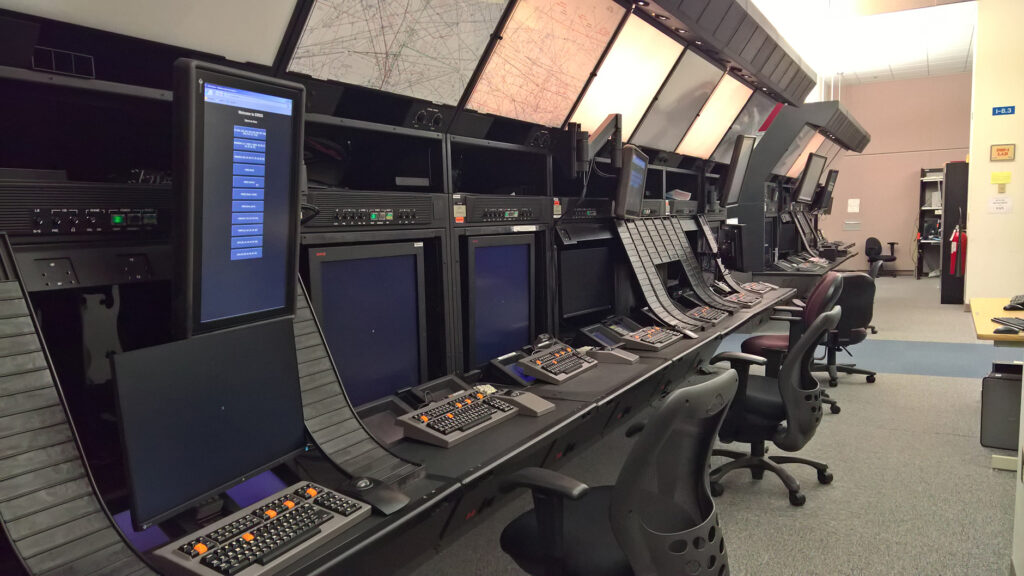 Source: https://www.eizoglobal.com/solutions/casestudies/atc/federal-aviation-administration/index.html
What Makes CCO/CDO Successful?
As the aviation industry moves toward a more sustainable future, small improvements across thousands of daily flights can make a significant cumulative impact.
Expanding the prevalence of CCO/CDO procedures is a method to improve flight and environmental efficiencies. In order to have successful CCO/CDO operations, the procedures and airspace need to ensure that traffic conflicts can be avoided, airspace capacity can be maintained, the SID/STARs are cost-effective for the operator, reduces workload for crew and Controllers while mitigating environmental impacts.
If these requirements can be consistently met during daily operators, then it can be said that the CCO/CDO procedure is a success.
Author
More News

Ensuring Continuous Tracking with ACARS
Ensuring Continuous Tracking with ACARS In modern flight operations, situational awareness depends on reliable aircraft tracking. Yet, even with...

The Evolution of NOTAMs
The Evolution of NOTAMs The concept of notifying pilots of changes or hazards impacting their flight dates back to the early days of aviation, when...
Aircraft Commerce FLOPS 2025
AIR SUPPORT will exhibit at the 18th Annual Flight Operations Conference, taking place December 3–4, 2025, at London Heathrow. Visit booth 10 to see...